
American Learning Institute for Muslims
  • About
    • Our History
    • Board of Trustees
    • Team
    • Testimonials
  • In Person
    • ALIM Summer Program >
      • Register Now
      • Financial Aid
      • Confirmed Scholars
      • Course Descriptions
      • Testimonials
      • FAQ
      • Refer or Sponsor
      • Highlights
      • Photo Gallery
      • Sample Schedule
      • Welcome Packet
      • Facilitator Application
    • ALIM Umrah Trip
  • Virtual
    • Pre-Ramadan Live Event
    • Book Club
    • Winter Program: Building Consensus & Unity
    • Istighfar & Tawbah Course
    • Navigating Post-Modernity
    • Malcolm X
  • Media
    • Frames Podcast
    • Blog >
      • Ust. Ubaydullah Evans
      • Dr. Sherman Jackson
      • Dr. Muneer Fareed
      • Dr. Ali Sulaiman Ali
      • Reel Talk
    • YouTube
    • News
  • Scholars
    • Request a Scholar
    • ALIM Core Scholars >
      • Dr. Sherman Jackson
      • Dr. Muneer Fareed
      • Dr. Ali Sulaiman Ali
    • Scholar in Residence >
      • Ustadh Ubaydullah Evans
    • Guest Scholars >
      • Imam Mohamed Hag Magid
      • Dr. Hadia Mubarak
      • Mohammed Tayssir Safi
      • Usta. Zaynab Ansari
      • Imam Zaid Shakir
      • Dr. Umar Faruq Abd-Allah
      • Dr. Jawad Qureshi
      • Dr. Zainab Alwani
      • Ust. Shad Imam
      • Dr. Jonathan Brown
      • Dr. Ovamir Anjum
      • Dr. Omar Nasim
      • Dr. Omar Suleiman
      • Dr. Sulayman Nyang
      • Dr. Ingrid Mattson
      • Imam Dawud Walid
  • Contact
    • ​Alim Email Sign-Up
  • Support
    • Endowment Fund

Blog


Watch What You Say

2/11/2023

0 Comments


By: Ust. ubaydullah evans

Picture
“Divorce may be retracted twice, then the husband must retain ‘his wife’ with honor or separate from her with grace…” [2:229]
​

My father’s absence is one of the most vivid memories of my childhood. From a very young age, I was keenly aware of the ways in which the dynamics of our single-parent family vexed my mother. I wanted to see someone care for her and provide our family with stability and leadership. Thus, even as a young man, I fetishized the idea of the nuclear family. And although I’ve critically examined this, I have no doubt my penchant for prioritizing family cohesion colors my judgment at times. Accordingly, whenever my opinion is sought about divorce, it is always advisable for the person seeking naṣīḥa to get a second opinion. If there are children involved and the situation is not positively unsalvageable (in other words, not involving abuse or infidelity), I always encourage the couple to reconcile.
And so there I was; with the disposition I explained, when I received a call early one morning from a brother in the community. His voice was hoarse and weakened. In a somber tone, he said: “I did it. I never thought I would, but I did.” “Ease up; what are you referring to, akhi?” I responded in a deliberate attempt to calm him. He continued, “I lost it last night and pronounced a 3rd divorce. It’s over.” His remorse was palpable and as I sat commiserating with my brother, my mind raced. First, I established the facts: 3rd divorce or what is known in the Islamic legal tradition as “talāq mughallaẓ” or conclusive divorce, 3 separate occasions NOT 3 times on 1 occasion, 3 children, married more than a decade, he and his wife want to reconcile. 

The practical impact of conclusive divorce is nearly a matter of unanimous consensus in Islamic law. After the issuance of a 3rd divorce, the erstwhile married couple is to be immediately separated. The possibility of reconciliation is effectively precluded until after the former wife remarries and divorces someone else. Both the legal and exegetical traditions make the rationale of the verse clear: The verse is intended as a protection for women against being arbitrarily threatened with the possibility of divorce. The precariousness of such a predicament, which in the Quranic idiom is referred as being mu’allaqa (suspended or hanging), is deemed oppressive to women and thus prevented. In retrospect, it’s clear that the Quranic verse and subsequent ruling carry strong moral implications. A wife should be protected against her husband’s ability to use divorce as some kind of yo-yo.  And perhaps just as importantly, that commitment and stability are the basic requirements of the institution of marriage. Stated differently, how can one build a life with someone if the relationship is constantly “on and off.”

Nonetheless, we are all shaped by our own individual experiences. I am not the son of a woman whose mental health or self-esteem was eroded by a man who constantly dangled the possibility of separation in front of her. If I had been, perhaps I would have innately approached the situation differently. I am who I am so my mind went into overdrive considering any fiqh opinions or practical precedents (fatwa) that could be employed to keep this family together. Among the Malikis, Hanafis, and Shafi’is, I found nothing; neither in the classical legal compendia nor contemporary practical rulings based on their respective methodologies. However, the school of Imam Aḥmad ibn Ḥanbal; specifically contemporary scholars using the methodology of the school, did offer something of interest. Their view maintains that the soundness and effectiveness of a divorce pronouncement are contingent upon the clarity and deliberateness of the husband when making the pronouncement. I directed the brother to a specialist of this school and I’m still actually unclear as to the outcome. My earnest prayer is that there is a legitimate shar’i basis upon which this brother and his wife can reconcile and their household remains intact.  

However, the purpose of this short blog post is not to suggest that no matter what happens, Islamic law, in its expansiveness, can be instrumentalized to legitimate a basis upon which we can preserve our families. I’m personally vested in the institution of family, so I advocate stretching the law (to its legitimate limits) for its preservation. I won’t apologize for that. Yet, I recognize that protecting family is not the sole responsibility of Islamic law. Rather, brothers and sisters, and in cases like the one I encountered, specifically brothers must be encouraged to have greater self-control and discipline. “A wise man’s tongue is behind his heart while a fool’s heart is in his mouth.” 

Disciplining the tongue has always been a point of emphasis within Islamic moral education. Our context, however, might warrant added focus. In a certain sense, our world elevates the importance of written contracts and reduces the gravity of speech. Although verbal contracts are technically binding in most articulations of American civil law, our vernacular culture tends to be more permissive with regard to speech. There is much reverence for that which is “etched in stone” while “talk is cheap.” In Islamic law, talk is anything but cheap. In an authentic Prophetic tradition, the following has been offered by way of illustration: “There are three matters in which being facetious and being serious have the same impact: Marriage, divorce, and reconciling after divorce.” Put succinctly, the Prophet (upon him be peace) is informing the community that there are some pronouncements whose intent is irrelevant.These statements take effect as soon as they are made. In truth, I do find this quite daunting. We live in a context in which it isn’t a standard procedure to make contractual agreements with speech alone. And yet the most important relationship in most of our lives can be irreparably harmed simply by speaking irresponsibly.
​

For all practical intents and purposes, couples should understand the raging torrent of emotions produced by marital tension, strife, and argumentation. In light of these, they should introduce ironclad protocols that make the mention of the word “divorce” (in any language) inadmissible in an argument. Perhaps one way of realizing this objective is that the couple adds (as conditional) a stipulation in the marriage contract to the effect that all decisions to end the relationship (divorce) must occur in the presence of witnesses. This is not without precedent. In fact, commissioning witnesses for divorce is recommended in all of the Sunni legal schools. We must be more careful about this, brothers and sisters.

Picture

About the author:

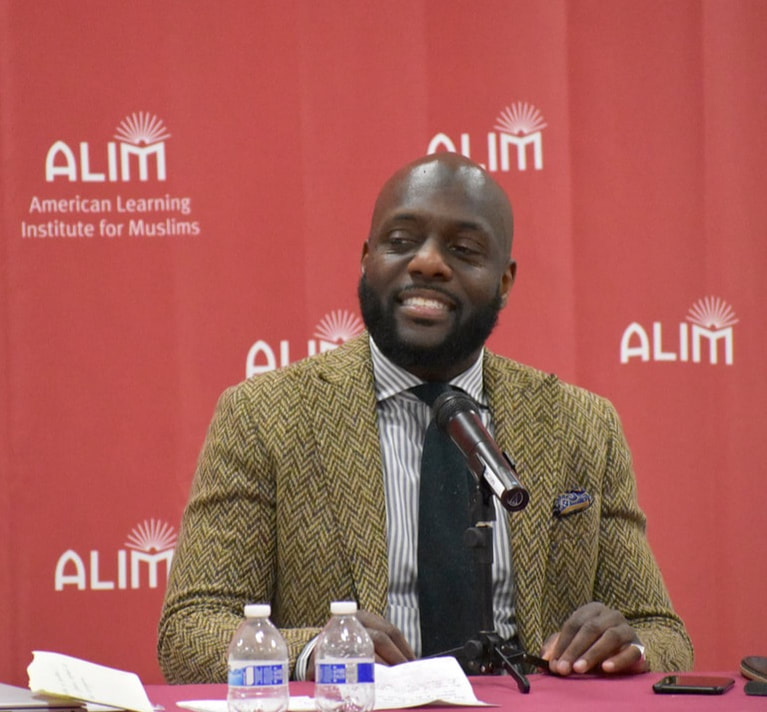
Ustadh Ubaydullah Evans is ALIM’s first Scholar-in-Residence. He converted to Islam while in high school. Upon conversion, Ustadh Ubaydullah began studying some of the foundational books of Islam under the private tutelage of local scholars while simultaneously pursuing a degree in journalism from Columbia.

Since then, he has studied at Chicagoland’s Institute of Islamic Education (IIE), in Tarim, Yemen, and Al-Azhar University in Cairo, Egypt, where he is the first African-American to graduate from its Shari’a program. Ustadh Ubaydullah also instructs with the Ta’leef Collective and the Inner-City Muslim Action Network (IMAN) at times.

As the ALIM Scholar-in-Residence, Ustadh Ubaydullah is a core instructor at the ALIM Summer Program. He teaches History of Islamic Law, Shama'il, and Aphorisims of Ibn Ata'illah along with other courses.

0 Comments


Leave a Reply.

Join Our Mailing List

Get exclusive content and updates straight to your inbox.

By subscribing, you agree to receive occasional emails from ALIM. View terms.

 stay connected
​@alimprogram

Support ALIM
Summer Program
PO Box 871785 Canton, MI 48187
(734) 956-0698
2025 © American Learning Institute for Muslims. All rights reserved.
ALIM is a 501(c)(3) organization. All donations are tax deductible. Our EIN is 38-3633579.
Zelle: [email protected]
​
​Terms of Service | Privacy Guidelines
  • About
    • Our History
    • Board of Trustees
    • Team
    • Testimonials
  • In Person
    • ALIM Summer Program >
      • Register Now
      • Financial Aid
      • Confirmed Scholars
      • Course Descriptions
      • Testimonials
      • FAQ
      • Refer or Sponsor
      • Highlights
      • Photo Gallery
      • Sample Schedule
      • Welcome Packet
      • Facilitator Application
    • ALIM Umrah Trip
  • Virtual
    • Pre-Ramadan Live Event
    • Book Club
    • Winter Program: Building Consensus & Unity
    • Istighfar & Tawbah Course
    • Navigating Post-Modernity
    • Malcolm X
  • Media
    • Frames Podcast
    • Blog >
      • Ust. Ubaydullah Evans
      • Dr. Sherman Jackson
      • Dr. Muneer Fareed
      • Dr. Ali Sulaiman Ali
      • Reel Talk
    • YouTube
    • News
  • Scholars
    • Request a Scholar
    • ALIM Core Scholars >
      • Dr. Sherman Jackson
      • Dr. Muneer Fareed
      • Dr. Ali Sulaiman Ali
    • Scholar in Residence >
      • Ustadh Ubaydullah Evans
    • Guest Scholars >
      • Imam Mohamed Hag Magid
      • Dr. Hadia Mubarak
      • Mohammed Tayssir Safi
      • Usta. Zaynab Ansari
      • Imam Zaid Shakir
      • Dr. Umar Faruq Abd-Allah
      • Dr. Jawad Qureshi
      • Dr. Zainab Alwani
      • Ust. Shad Imam
      • Dr. Jonathan Brown
      • Dr. Ovamir Anjum
      • Dr. Omar Nasim
      • Dr. Omar Suleiman
      • Dr. Sulayman Nyang
      • Dr. Ingrid Mattson
      • Imam Dawud Walid
  • Contact
    • ​Alim Email Sign-Up
  • Support
    • Endowment Fund