American Learning Institute for Muslims
  • About
    • Our History
    • Board of Trustees
    • Team
    • Testimonials
  • In Person
    • ALIM Summer Program >
      • Register Now
      • Financial Aid
      • Confirmed Scholars
      • Course Descriptions
      • Testimonials
      • FAQ
      • Refer or Sponsor
      • Highlights
      • Photo Gallery
      • Sample Schedule
      • Welcome Packet
      • Facilitator Application
    • ALIM Umrah Trip
  • Virtual
    • Pre-Ramadan Live Event
    • Book Club
    • Winter Program: Building Consensus & Unity
    • Istighfar & Tawbah Course
    • Navigating Post-Modernity
    • Malcolm X
  • Media
    • Frames Podcast
    • Blog >
      • Ust. Ubaydullah Evans
      • Dr. Sherman Jackson
      • Dr. Muneer Fareed
      • Dr. Ali Sulaiman Ali
      • Reel Talk
    • YouTube
    • News
  • Scholars
    • Request a Scholar
    • ALIM Core Scholars >
      • Dr. Sherman Jackson
      • Dr. Muneer Fareed
      • Dr. Ali Sulaiman Ali
    • Scholar in Residence >
      • Ustadh Ubaydullah Evans
    • Guest Scholars >
      • Imam Mohamed Hag Magid
      • Dr. Hadia Mubarak
      • Mohammed Tayssir Safi
      • Usta. Zaynab Ansari
      • Imam Zaid Shakir
      • Dr. Umar Faruq Abd-Allah
      • Dr. Jawad Qureshi
      • Dr. Zainab Alwani
      • Ust. Shad Imam
      • Dr. Jonathan Brown
      • Dr. Ovamir Anjum
      • Dr. Omar Nasim
      • Dr. Omar Suleiman
      • Dr. Sulayman Nyang
      • Dr. Ingrid Mattson
      • Imam Dawud Walid
  • Contact
    • ​Alim Email Sign-Up
  • Support
    • Endowment Fund

Blog


Ships Passing in the Night

12/2/2022

0 Comments


By: ustadh ubaydullah evans

Picture
In his seminal work on Islamic history, Conversion to Islam in the Medieval Period: An Essay in Quantitative History, Prof. Richard Bulliet makes a startling assertion: During some of the most fecund periods of Islamic history (the period sometimes romantically referred to as the “Golden Age” of Islamic civilization), Muslims were a religious minority within some of the central lands of Islam. Moreover, what we term classical “Islamic” civilization was in fact built by Jews, Christians, Zoroastrians, and Hellenistic philosophers inter alia. Stated more directly, Islam thrived in pluralistic societies. It had to define itself vis-à-vis traditions that were historically more established and numerically stronger. And yet, when considering our minority status in the US we hardly draw inspiration or even parallels from Muslim activity during that period. Why not? As opposed to seeing ourselves on the cusp of a renaissance, our community appears to harbor fears of being dissolved into the dominant culture. What can be said to account for this?  More importantly, can this trend be reversed or at the very least staunched?   
​I concede that many Muslim communities in the medieval period represented politically dominant minorities. This isn’t our reality. However, that historical fact aside, it is not a lack of political clout or relative paucity in numbers that inform our current state of ennui. Rather it is our inability to strike a balance between affiliation (intimā’) and independence (istiqlāl)—vis-à-vis the culture by which we are surrounded. To be sure, balancing these two fundamentally different postures is a kind of “golden mean.” It is incredibly difficult to harness two sets of cultural energies that appear to pull in opposite directions. When independence is weighted incorrectly we marginalize ourselves. By adopting a position of divestiture, we unwittingly forfeit our ability to influence the world around us. A worldview that leads to alienation will likely find itself jettisoned in favor of something more enabling. Nonetheless, when affiliation is weighted incorrectly we relinquish the ability to envision an independent future for ourselves. If American Muslims define themselves by way of the same categories and culture wars as everyone else, what is the utility of American Islam?

A thorough examination of the social realities of the productive medieval Muslim communities we referenced at the onset lies beyond the scope of this post. However, a broad survey of the literature (from al-Ghazālī to al-Jāḥiẓ and everything in between) of that time reveals a distinct intellectual attitude.   Namely, theirs’ was a discourse deeply-rooted in a religious worldview. Of course, this isn’t to say that writers of the period always wrote in a devotional register. Quite the reverse; we can’t discount Imam Ghazālī skewering the religious establishment of his time as a banal popularity contest in his famed Iḥyā ‘Ulūm ad-Dīn. Nor can we deny the general attitude of antipathy towards politics and politicians that characterizes many traditional Islamic works. We are unable to even deny the existence of the homoerotic poetry of Abū Nawwās or the heretical claims of al-Mutanabbī. Classical writers were at turns: satirical, irreverent, pietistic, humorous, etc. However, they treated the normative Islamic values that shaped their societies as a given. In this context, they could freely express their personal relationship to those values: from assiduous commitment to flagrant disregard. What is conspicuously absent from their writing—to the modern reader—is a distinctly post-structuralist impulse toward deconstruction. In other words, there’s a difference between reveling in impiety (which some Muslim poets definitely did) and reducing piety to an attempt to sanctify the wishes of a group of self-interested, powerful men. In a certain sense, reveling in impiety, while sinful, may be viewed as authentic self-disclosure from the underbelly of Islamic culture. On the other hand, the deconstruction of piety is not limited to self-disclosure. It is to declare piety illegitimate.

In an interview, American academic and cultural critic, Camille Paglia perceptively noted that post-structuralism and deconstruction are attractive to “people who no longer believe in themselves.” It’s as if uncovering the false universals of Modernity has produced a deep cynicism within the West. What was heralded as a triumph of reason, freedom, and empiricism proved itself capable of great moral evil. As a result, the prevailing cultural attitude is often one that prides itself on skepticism toward universals and disdain for hierarchies. 

The American Muslim community might possibly view the aforementioned cultural dynamics as fertile soil for our own emergence. Lamentably, as opposed to expressing an independence of vision, we appear to be subsumed in the cultural trends of those around us. So as not to be understood, I am not an advocate of a Huntingtonian “clash of civilizations” thesis. There is nothing in the US Constitution nor the scriptures or lived realities of American Muslims that would frustrate our embrace of conviviality and pluralism. The independence I have in mind is one of trajectory: A culture that has enjoyed unrivaled wealth, influence, and power awakening to its moral transgressions and critiquing itself into oblivion is a ship upon a course. A faith community that is religiously obliged to similarly hold itself accountable and atone for past mistakes but does so with the aim of tajdīd (renaissance/renewal) is a ship passing in the opposite direction.

Dr. Sherman Jackson shared an illuminating insight into Islamic civilization in the classical period. After disabusing the students of the idea that the classical period was a mythical utopia, he stated: “What Muslims were able to achieve at the height of their civilization was to create a centripetal force around their commitment to Islam. That centripetal force could pull everything around it, even the crazy stuff at the periphery, into its civilizational vision.” Our minority status isn’t arresting our development as a community. The pluralism that shapes our world is not an impediment to fostering strong Muslim communities. It is the strength of our commitment and the independence of our vision that will define us.                  ​
Picture

about the Author

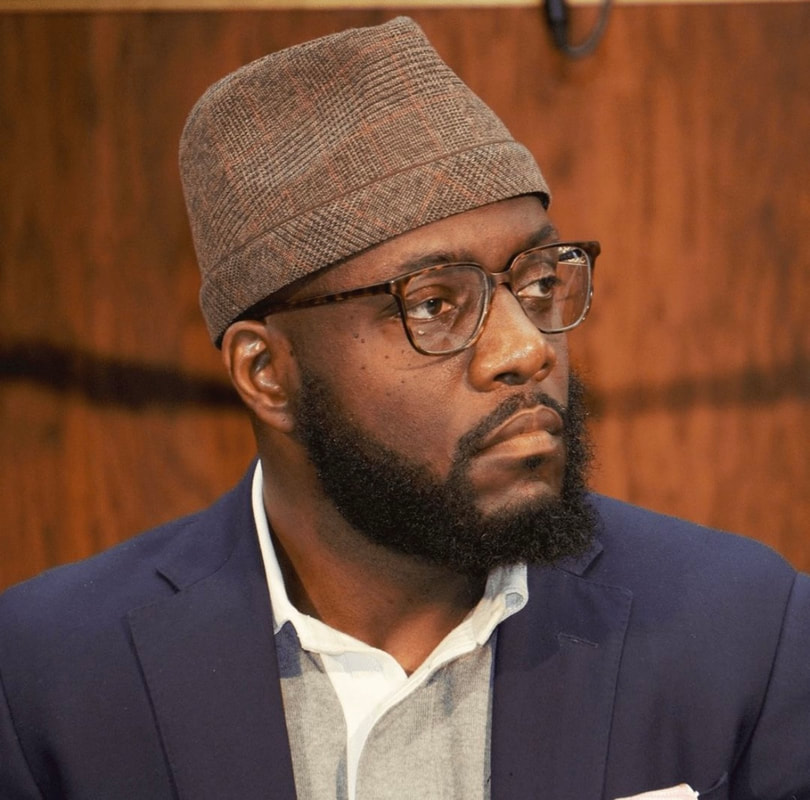
Ustadh Ubaydullah Evans is ALIM’s first Scholar-in-Residence.  He converted to Islam while in high school. Upon conversion, Ustadh Ubaydullah began studying some of the foundational books of Islam under the private tutelage of local scholars while simultaneously pursuing a degree in journalism from Columbia. Since then, he has studied at Chicagoland’s Institute of Islamic Education (IIE), in Tarim, Yemen, and Al-Azhar University in Cairo, Egypt, where he is the first African-American to graduate from its Shari’a program.

Ustadh Ubaydullah also instructs with the Ta’leef Collective and the Inner-City Muslim Action Network (IMAN) at times. As the ALIM Scholar-in-Residence, Ustadh Ubaydullah is a core instructor at the ALIM Summer Program. He teaches History of Islamic Law, Shama'il, and Aphorisims of Ibn Ata'illah along with other courses.

0 Comments


Leave a Reply.

Join Our Mailing List

Get exclusive content and updates straight to your inbox.

By subscribing, you agree to receive occasional emails from ALIM. View terms.

 stay connected
​@alimprogram

Support ALIM
Summer Program
PO Box 871785 Canton, MI 48187
(734) 956-0698
2025 © American Learning Institute for Muslims. All rights reserved.
ALIM is a 501(c)(3) organization. All donations are tax deductible. Our EIN is 38-3633579.
Zelle: [email protected]
​
​Terms of Service | Privacy Guidelines
  • About
    • Our History
    • Board of Trustees
    • Team
    • Testimonials
  • In Person
    • ALIM Summer Program >
      • Register Now
      • Financial Aid
      • Confirmed Scholars
      • Course Descriptions
      • Testimonials
      • FAQ
      • Refer or Sponsor
      • Highlights
      • Photo Gallery
      • Sample Schedule
      • Welcome Packet
      • Facilitator Application
    • ALIM Umrah Trip
  • Virtual
    • Pre-Ramadan Live Event
    • Book Club
    • Winter Program: Building Consensus & Unity
    • Istighfar & Tawbah Course
    • Navigating Post-Modernity
    • Malcolm X
  • Media
    • Frames Podcast
    • Blog >
      • Ust. Ubaydullah Evans
      • Dr. Sherman Jackson
      • Dr. Muneer Fareed
      • Dr. Ali Sulaiman Ali
      • Reel Talk
    • YouTube
    • News
  • Scholars
    • Request a Scholar
    • ALIM Core Scholars >
      • Dr. Sherman Jackson
      • Dr. Muneer Fareed
      • Dr. Ali Sulaiman Ali
    • Scholar in Residence >
      • Ustadh Ubaydullah Evans
    • Guest Scholars >
      • Imam Mohamed Hag Magid
      • Dr. Hadia Mubarak
      • Mohammed Tayssir Safi
      • Usta. Zaynab Ansari
      • Imam Zaid Shakir
      • Dr. Umar Faruq Abd-Allah
      • Dr. Jawad Qureshi
      • Dr. Zainab Alwani
      • Ust. Shad Imam
      • Dr. Jonathan Brown
      • Dr. Ovamir Anjum
      • Dr. Omar Nasim
      • Dr. Omar Suleiman
      • Dr. Sulayman Nyang
      • Dr. Ingrid Mattson
      • Imam Dawud Walid
  • Contact
    • ​Alim Email Sign-Up
  • Support
    • Endowment Fund